RSD's 150th Anniversary
In 2026, Rochester School for the Deaf celebrates its 150th Anniversary. RSD was founded on February 3, 1876, and opened to students on October 4, 1876.
Save the Date for our 150th Anniversary Celebration!
150th Anniversary Gala
Saturday, October 24, 2026
Hyatt Regency Rochester
Sponsorships available
General admission tickets | $150
Alumni/staff tickets | $100 (max 2 tickets at this price)
TICKETS ON SALE NOW
Please reserve your tickets by October 1.
Alumni Reunion
October 23-25, 2026
RSD Campus
October 23-25, 2026
RSD Campus
One person | $50
Two people | $75 for two
Kids ages 11–18 | $10
Kids 10 and under | Free
At-the-door registration | Add $10 to the listed price
*Non-refundable*
Registration link:
Tentative Reunion Schedule*
Friday, October 23
RSD Museum & Archives Tours
Decades Panel
RSD 150th Celebration with students, staff, and alumni
Alumni vs. Alumni Volleyball & Soccer Games
Gathering
Saturday, October 24
RSDAA General Meeting
Cookout
Class photos
RSD Gala
Sunday, October 25
RSDAA Breakfast Farewell Gathering
Hotel Room Block
Rochester Hyatt Regency
Starting at $165 a night
Please note that this block has a limited number of rooms, available on a first-come, first-served basis. If it is full, please let us know at [email protected] and we can try to add rooms to the block. Hotel room prices fluctuate depending on demand and better pricing may be available through other booking sites. The room block is for Saturday night only, but the Hyatt will honor the price for adjacent nights when booked through the link.
150th Logo Features Perkins Hall
 Perkins Hall was the first building on campus and its iconic facade represents "home" to generations of alumni and staff. As such, we were eager to include it in the 150th logo. While the staircase has changed to accommodate a second exit from the basement of Perkins, the logo reflects the building from its earliest days, with a grand front staircase and a picket fence.
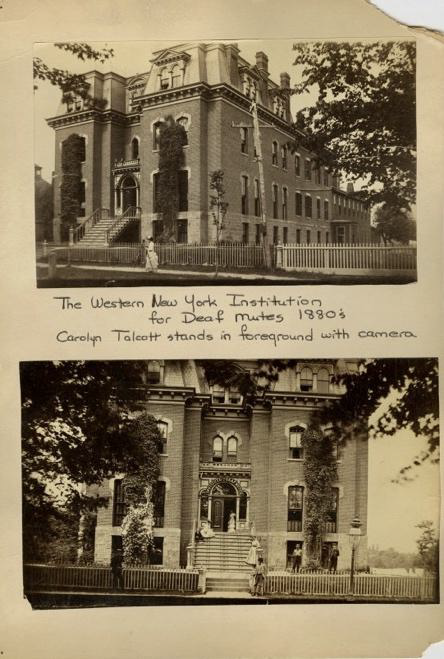
 Perkins Hall is named for Mr. and Mrs. Gilman H. Perkins, who had a deaf daughter (Carolyn Perkins). Their search for a tutor for Carolyn eventually brought together educators, donors, parents, and city leaders to create the Western New York Institution for Deaf Mutes in 1876.
The school moved to its current location from downtown Rochester in 1878, having outgrown its initial space. This was farmland at the time, and the school initially leased the building and seven and a half acres from the city for $500 a year, and then renewed it for $1 a year, eventually purchasing the campus from the city for $20,000.
From the Archives: A Snapshot of RSD in 1890
From Founders' Day on February 3 to the Gala on October 26, 2026, we will share RSD's rich and proud history with images, stories, and profiles. Thank you to our friends in the Archives -- especially Frederich L. Koch (Principal 1979-1987, Assistant Superintendent 1987-2002), Harold Mowl (Superintendent 1990-2015), and Mary Mowl -- for compiling the stories and articles that bring the school's history and legacy to life.
Let us start with an article that was written in 1890 by Mrs. Arthur Sutherland for "The Lighthouse," a paper published by the Asbury Church of Rochester. It gives a snapshot of life at Rochester School for the Deaf, then known as the Western New York Institution for Deaf Mutes. Enjoy this glimpse into our school's history.
Where the Light Shines
The lamp that Asbury's young people keep trimmed and burning on their tower, lights up many places which without its wide-spreading rays would be hidden from our mind's eye. Its beaming discloses much that interests us, while our hearts are warmed by its kindly glow. It now discovers to us a group of buildings near the northern limit of the city. They stand on the east bank of the Genesee River, not far below the lower Falls. Well-kept lawns, with fine shade-trees surround two substantial buildings of red brick; and two of gray-painted wood. At certain hours of the day the doors open, and throngs of children rush out to play.
Strangers passing by often stop to watch games of baseball and tennis. Sleds, skates, and snowballs likewise have their day.
Advancing toward the main entrance we read the inscription which arches the doors, "Western New York Institution for Deaf-Mutes." And now we know why the games of those children on the lawns are so much more interesting to the passers-by than the same amusements would be in an ordinary school playground.
Having entered through the hospitable doors we receive assurance by word and manner that "visitors are welcome." We learn that there is a regular attendance of 160 pupils, with 175 names on the roll. Each pupil spends six hours a day in study and recitation, and two in the industrial training classes.
There is an excellent printing office where the pupils publish The Daily Paper For Our Little People, a journal of their school life, also containing summaries of news of the day. A carpenter shop, paint shop, and engine room, each with a competent foreman in charge, furnish instruction to the boys. They also learn gardening on the fine eighteen-acre farm across the street.
The girls are taught to cut, make, and mend their clothes, to keep their rooms in perfect order, and to cook. Some girls have also received instruction in the printing office.
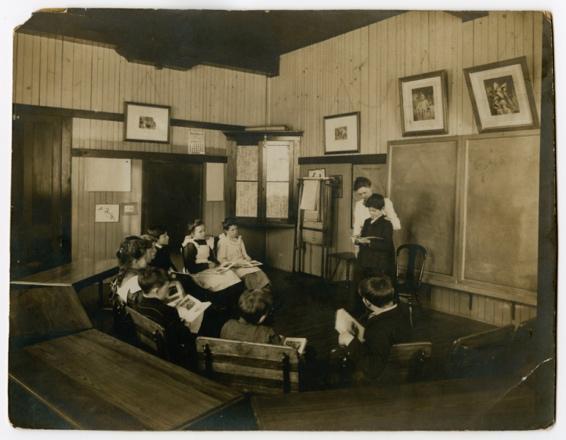 Pupils are received into the Kindergarten at the age of six. Here they may spend six years at the expense of the county from which they are appointed. Then they are promoted to the Primary Department, where they become "state pupils," and spend five years. At the expiration of this term, they are ready for the Grammar Department, and if sufficient progress is made in grammar studies for three years, they may receive a final three years' appointment as high-class pupils. In this class an academic course of study is pursued, and graduates are prepared for the National Deaf-Mute College in Washington, D.C., being ready for examinations in English, Latin, mathematics, and sciences.
It will be seen that there is a possible school period of seventeen years for each pupil who enters the Kindergarten at six years of age, but many do not come in until they are too old for that department. Others never attain proficiency to undertake higher studies, and yet others enter late, advance rapidly, and finish the course in a few years.
The Institution is not, as many suppose, a State Institution, but it is a private enterprise incorporated under the laws of the State. The property is vested in a board of fifteen trustees, all of whom are respected citizens of Rochester, except for Rev. Thomas Gallaudet, who is rector of a church in New York City.
The Y.M.C.A. building now marks the location where this school was organized about fourteen years ago. It was soon removed to its present commodious and pleasant quarters.
In 1882, the school lost seriously by fire, and at that time received the only gifts of importance which have ever been bestowed upon it. Fifteen hundred dollars was contributed, $1,200 of which came from persons employed in the institution on salary. There have since been gifts of books of reference, and a small sum towards founding an Art Department. The Institution shares with our public schools the supervision of the State Department of Education. The State Board of Charities also makes visits of inspection.
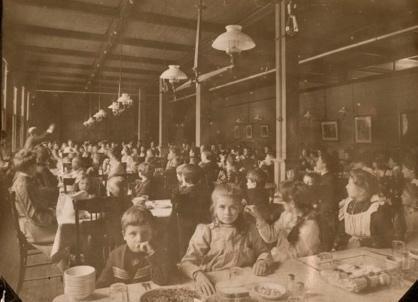 Seven teachers have charge of the Literary classes and five are employed in the Kindergarten. Twenty officers, supervisors, and attendants have charge of the pupils constantly out of school hours. This close supervision is in no wise irksome to the children, and a visitor, after spending a week there, said "The general control of the Institution seems to lie in an invisible moral power, more influential than welted flesh and stinging palms."
Christian worship, faith, and practice are inculcated both by precept and example. At the Sunday morning services the pupils spell hymns in concert, using the manual alphabet. The principal leads in prayer and delivers an address by the same means, and all unite in speaking or spelling the Lords' Prayer. On Sunday the teachers meet their respective classes for an hour's study of the International S.S. Lesson, after which the two voluntary missionary societies of the school meet in short session. That composed of the older pupils is called the "Silent Workers" and the little children's society is known as the "Little Helpers." For seven years they have supported two Indian boys whom they have named Paul and John. One is now in the high school in Madras, and the other in college. It is hoped that they may become teachers of the deaf in India, although no school had been established for them there yet.
Six years earlier, Mrs. Annetta Thompson Mills gave up teaching in the Institution to become a missionary in Che Foo, China. Like all who have been associated with the deaf, she is full of love for them, and has formed a class of five native deaf-mute children. These she has been instructing for more than a year and their progress is satisfactory. So far, the "Silent Workers" and the "Little Helpers" have been able to furnish what help Mrs. Mills needed, as expenses of living in China are slight. She now wishes to establish a school in that country where some of its 300,000 neglected deaf can be educated. The superintendent of the school for the deaf in Rochester will be glad to receive and forward contributions for this work.
From the school here a few teachers have gone as missionaries to foreign lands. Among them Mrs. Lucy McGill Waterbury, went to India, Mrs. Mill to China, Miss Dauphin to Alaska, Miss Snow to Mexico, and Miss Metcalf to Africa.
Much, necessarily, remains unsaid in a brief sketch like this, but if through it any readers have become interested in one of Rochester's noblest charities, the writer is happy, and trusts that what has been attempted in this article will be supplemented by visits to 945 North St. Paul Street.